4.0潮よ
A second piece: the tide
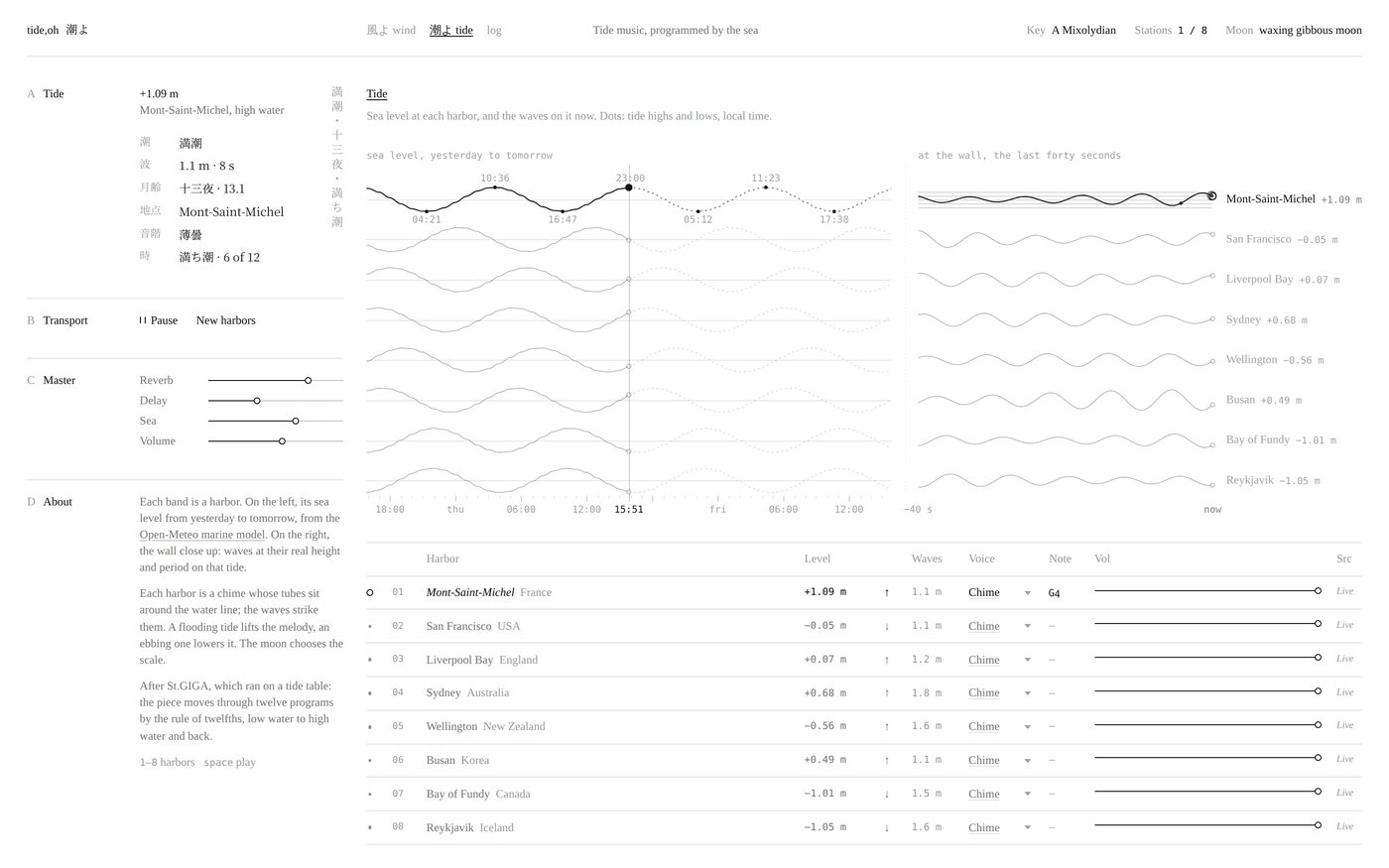
Eight harbors' sea levels from a marine model, the waves on them, and a chime at each harbor wall that the waves strike. The flood lifts the melody; the ebb lowers it. The moon phase sets the scale.
This is St.GIGA's idea taken literally: the program follows the tide by the rule of twelfths, low water to high and back. Both pieces now share one engine, one type system, one way of drawing.
3.1Readings
Readings, and a way to just listen
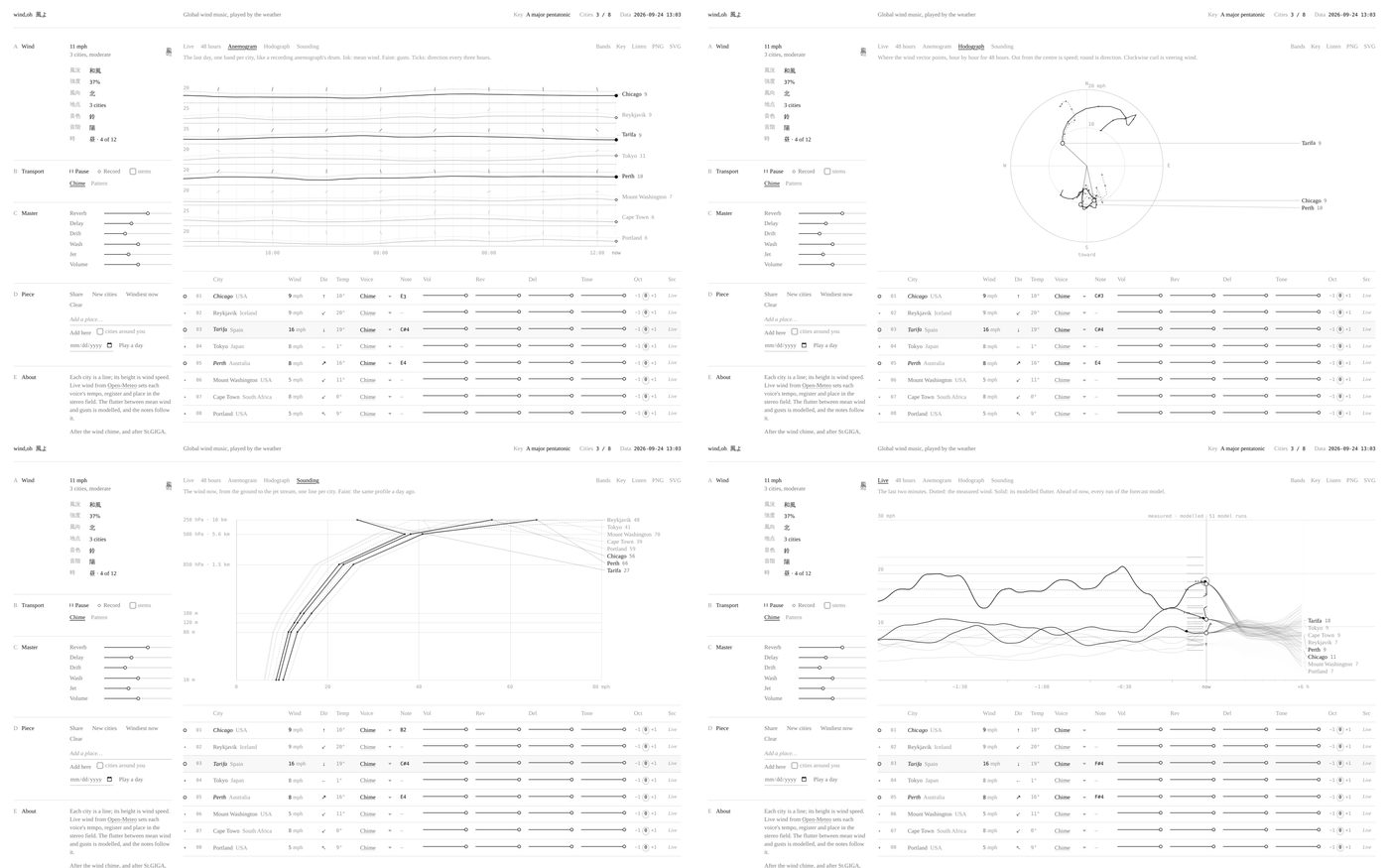
The same wind, read with the instruments meteorologists use: an anemogram (a drum of ruled paper, one ink line per city), a hodograph (the tip of the wind's arrow curling through two days), a sounding (the wind from the ground to the jet stream).
Listen mode takes everything else away. Any reading can be saved as an image; the 48 hours as vector lines, for prints.
3.0The chime
A chime again
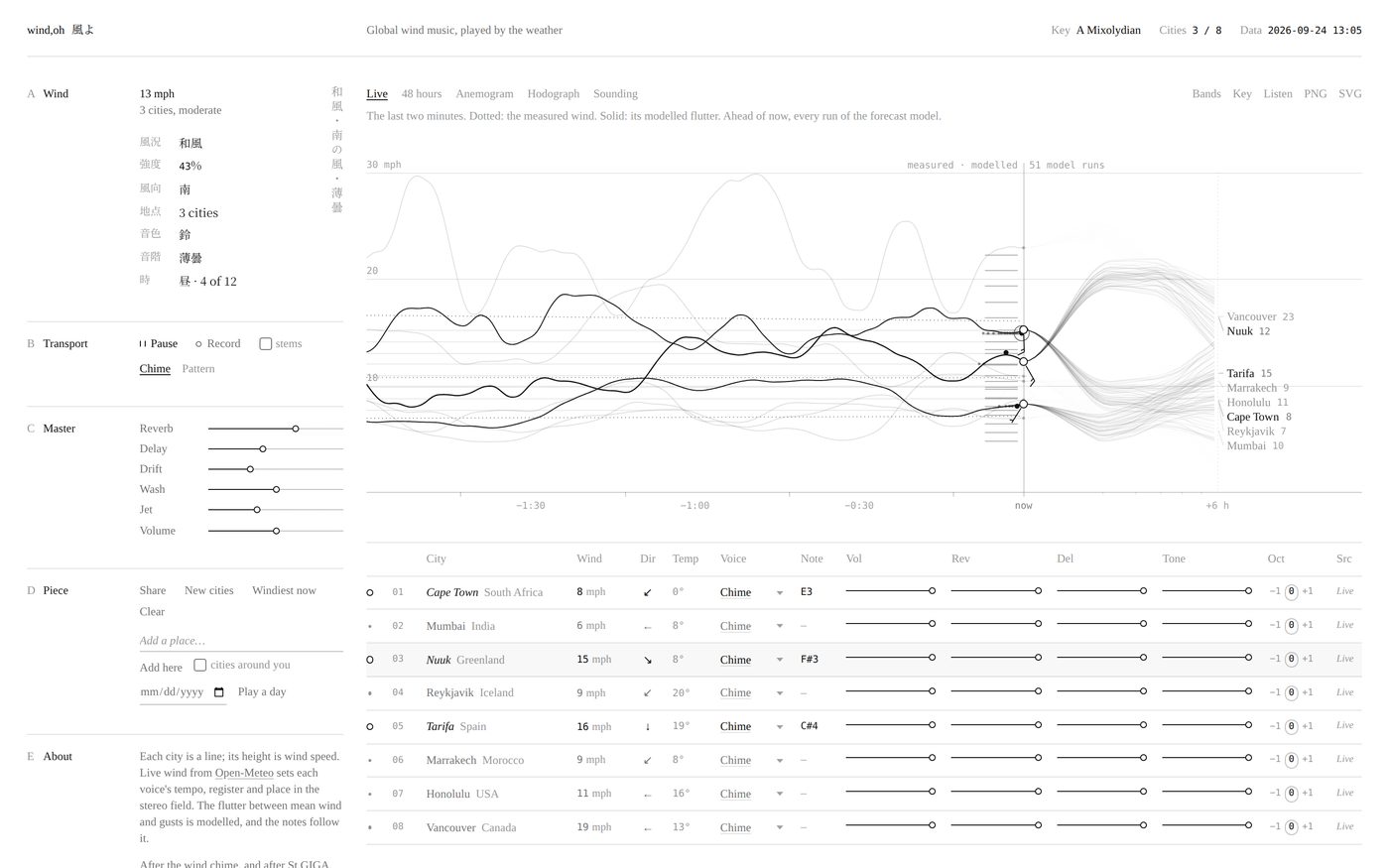
The notes used to come from a pattern table the weather chose. Now each city is a chime: eight tubes set across the range its wind is moving through, a clapper swinging on the wind line, a note wherever it crosses a tube. Calm air barely rings. A gust sweeps a chord.
The forecast fan became real: 51 runs of the ECMWF ensemble. The line became honest: dotted where it's measured, solid where it's modeled. The sky picks the scale, pressure picks the key, and the day is kept in twelfths.
2.1Type
Smaller, airier, and moving
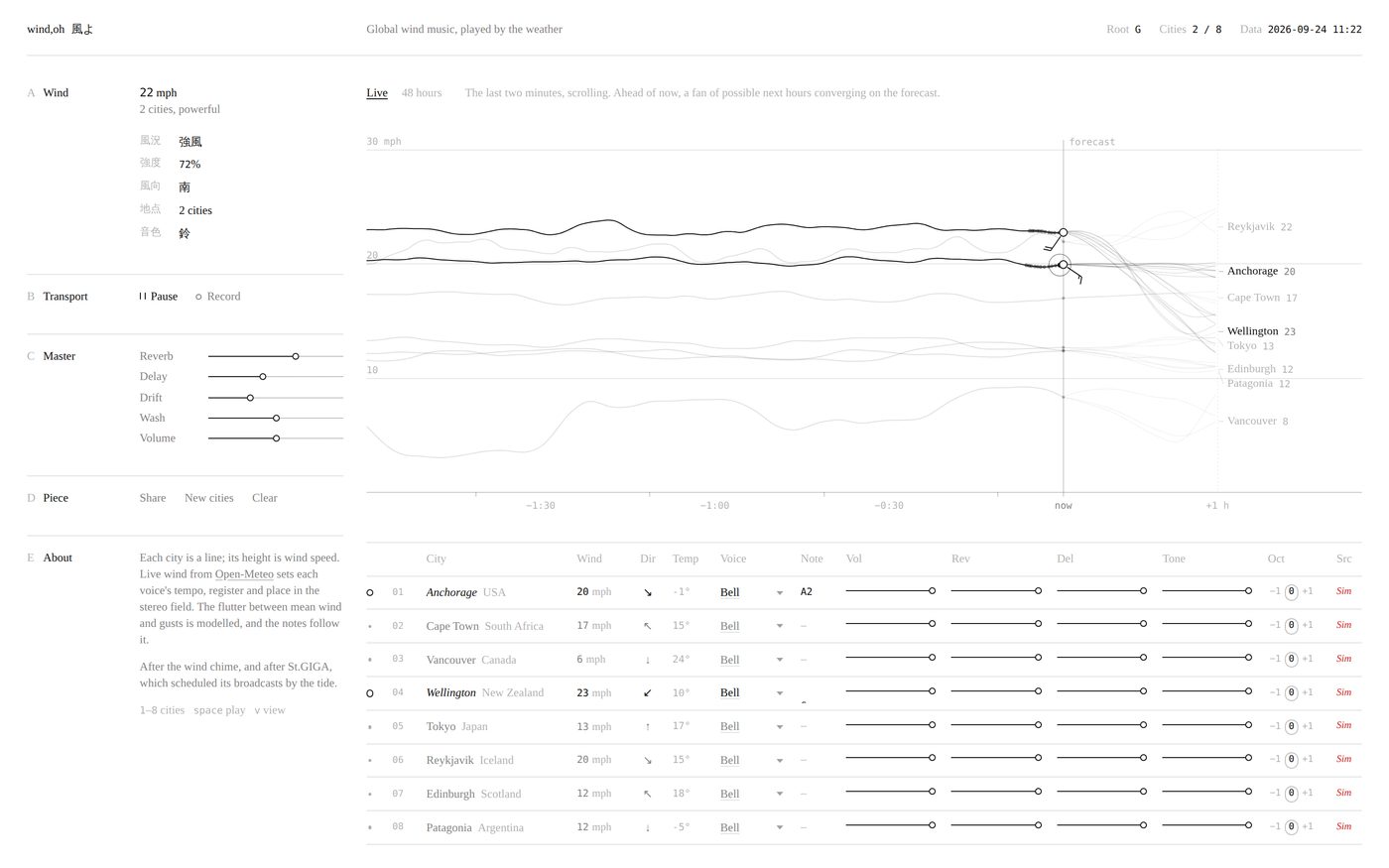
The type dropped to one small size with more room around everything. Installed kugiri for text effects - city's name leans the way its wind is blowing.
2.0Lines
From a grid to lines
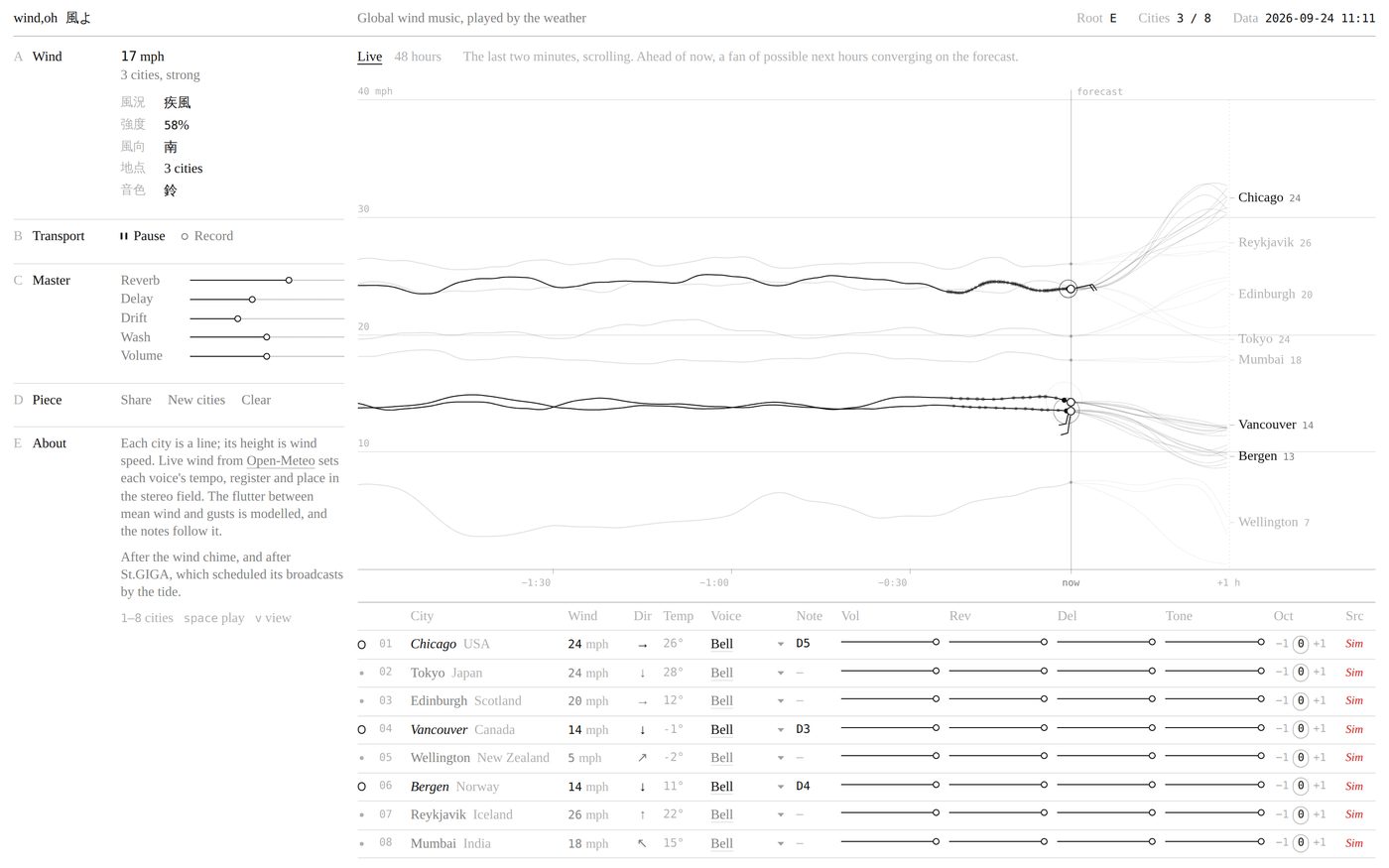
The grid was initially inspired by the incredible work of Il Pleut Studio and was more of a stopping-off point while I kept refining and marinating. I loved the look but it was too much of a rip-off so I wanted to keep evolving it. Lines are closer to wind: a trace scrolling like a chart recorder, a fan of possible futures, a barb pointing into the wind. A serif, one size, lettered sections.
1.4Chart
The grid becomes a chart
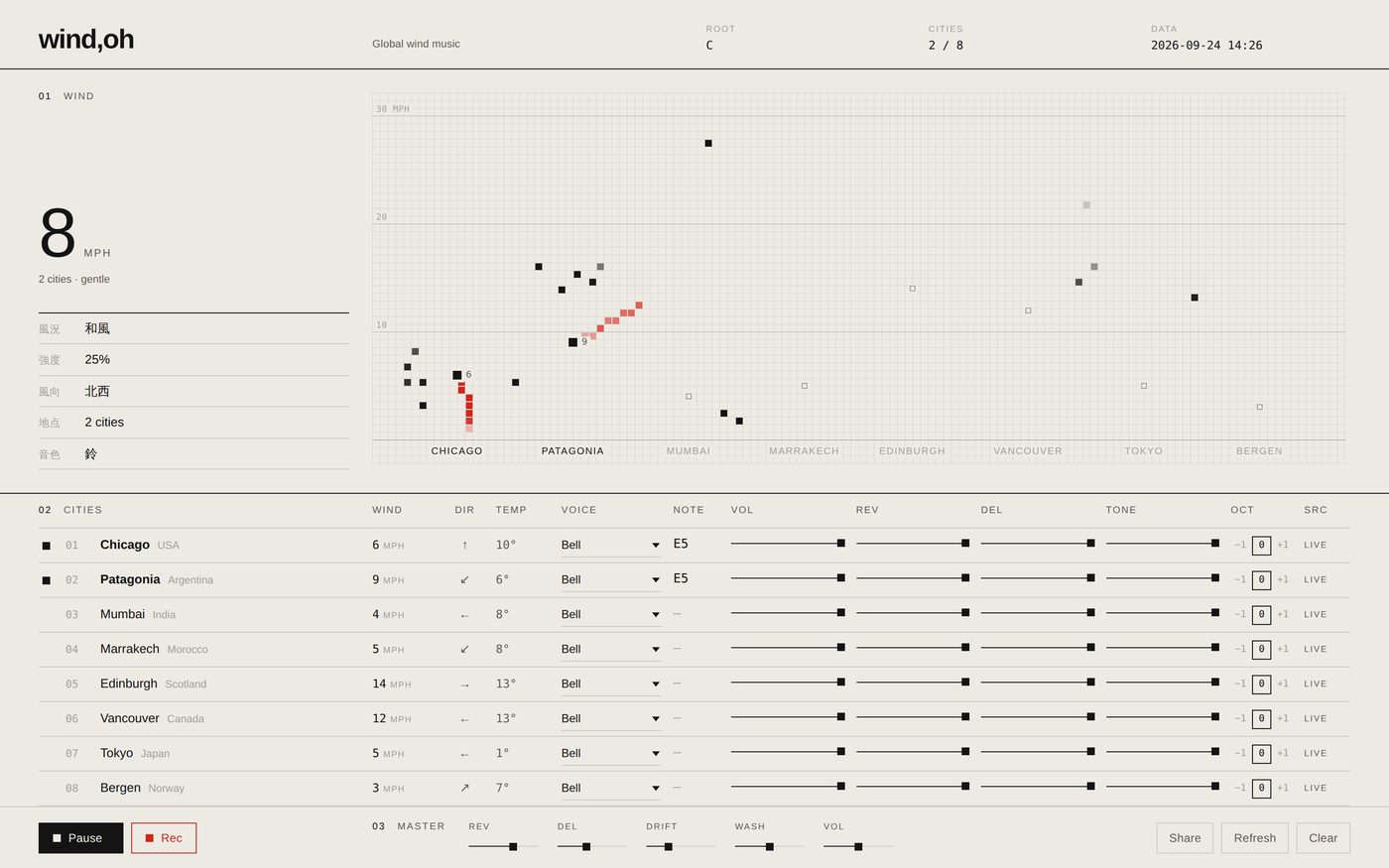
Each city got a channel and its mark sat at the height of its wind speed, with the names along the bottom. Sweeps blew through each mark along its real wind direction, and every note played flashed red from its city.
1.3Swiss
A Swiss typographic system
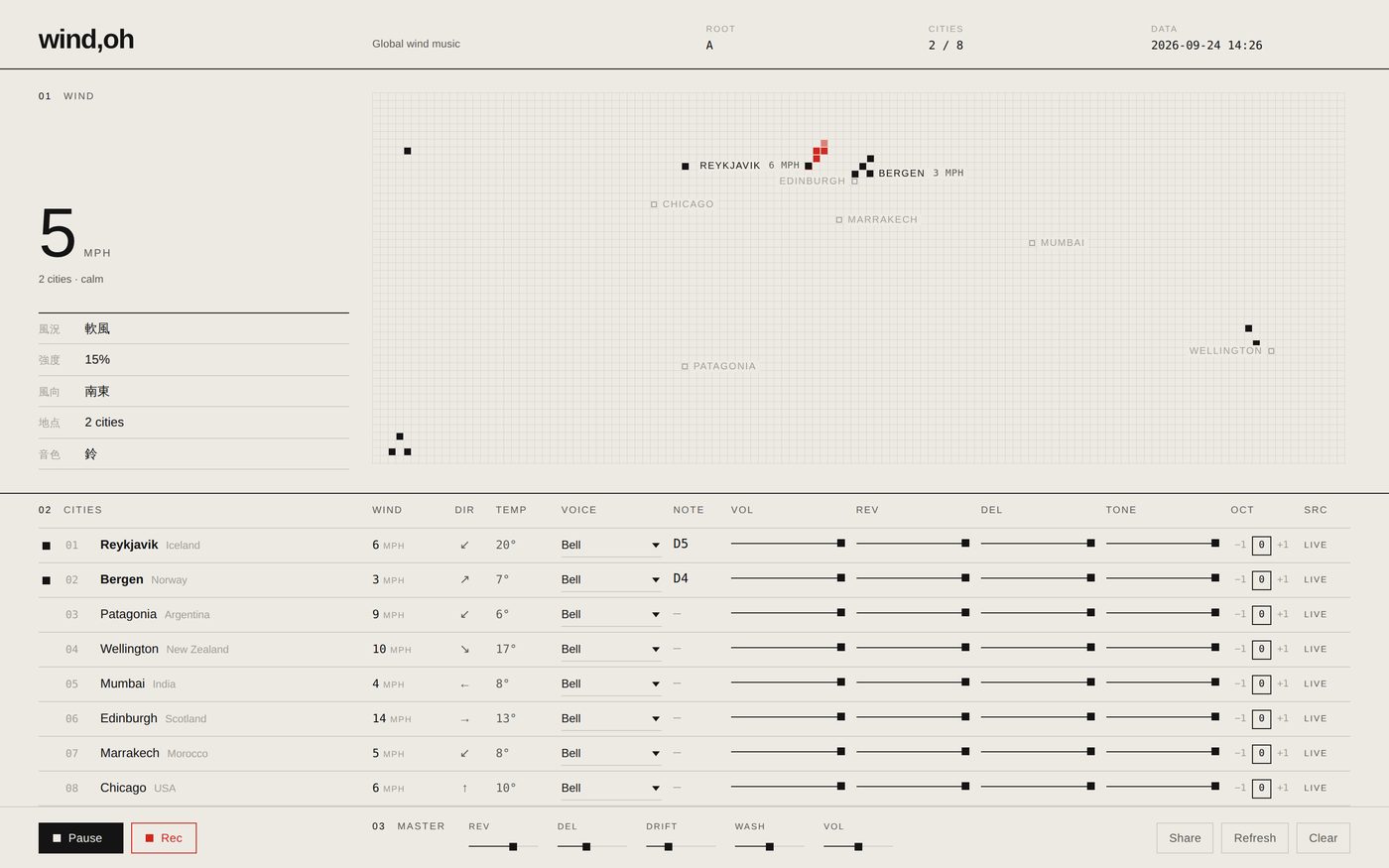
After Josef Müller-Brockmann: one twelve-column grid for every band of the page, one large figure, hairline rules. Every city got its own channel strip: volume, reverb, delay, tone, octave. A synthesized piano, and a delay that ran away and was tamed.
1.2Paper
Paper, and a home
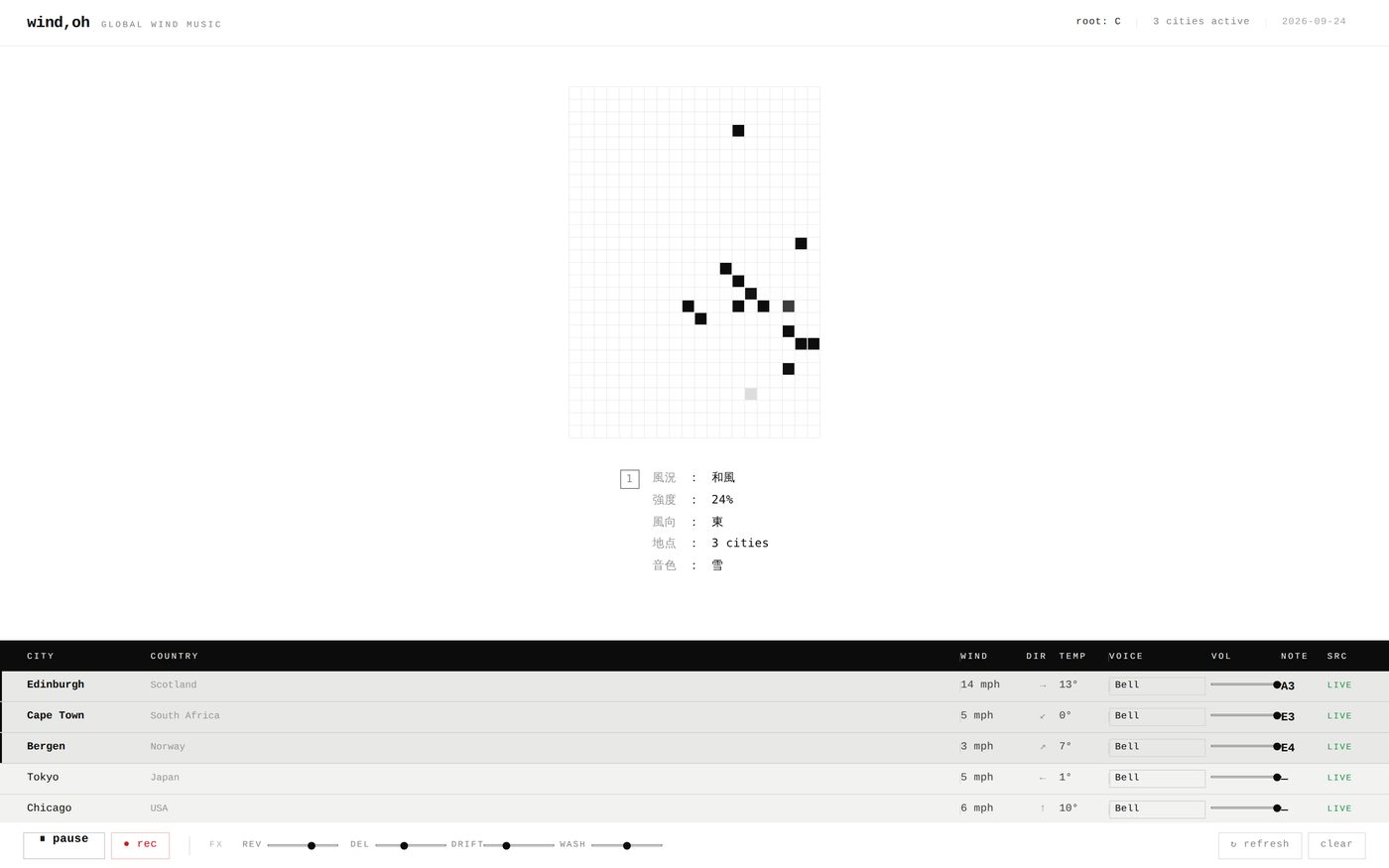
The grid moved onto a warm paper color, and the current key moved into the header. This is the version that went live at wind-oh.vercel.app and into version control.
1.1Grid
The first grid, and the wash
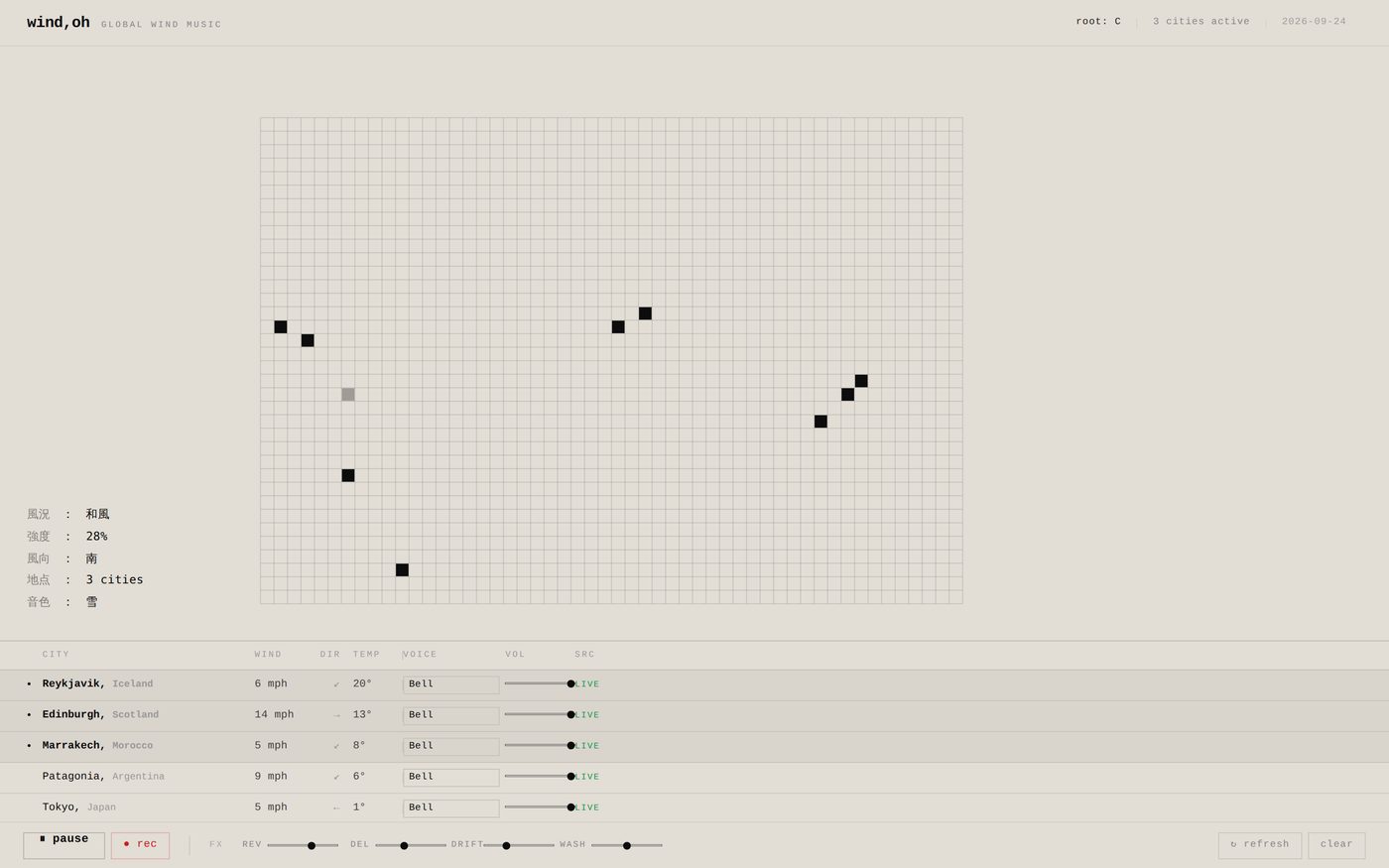
The cards gave way to a fine grid that filled cell by cell as the wind blew through it. A readout in Japanese appeared (風況, 強度, 風向, 地点, 音色), and so did the table of cities.
Underneath everything went a wash of synthesized noise, after St.GIGA, the Japanese satellite radio station that scheduled its broadcasts by the tide.
1.0Documented
Translating wind patterns into sound
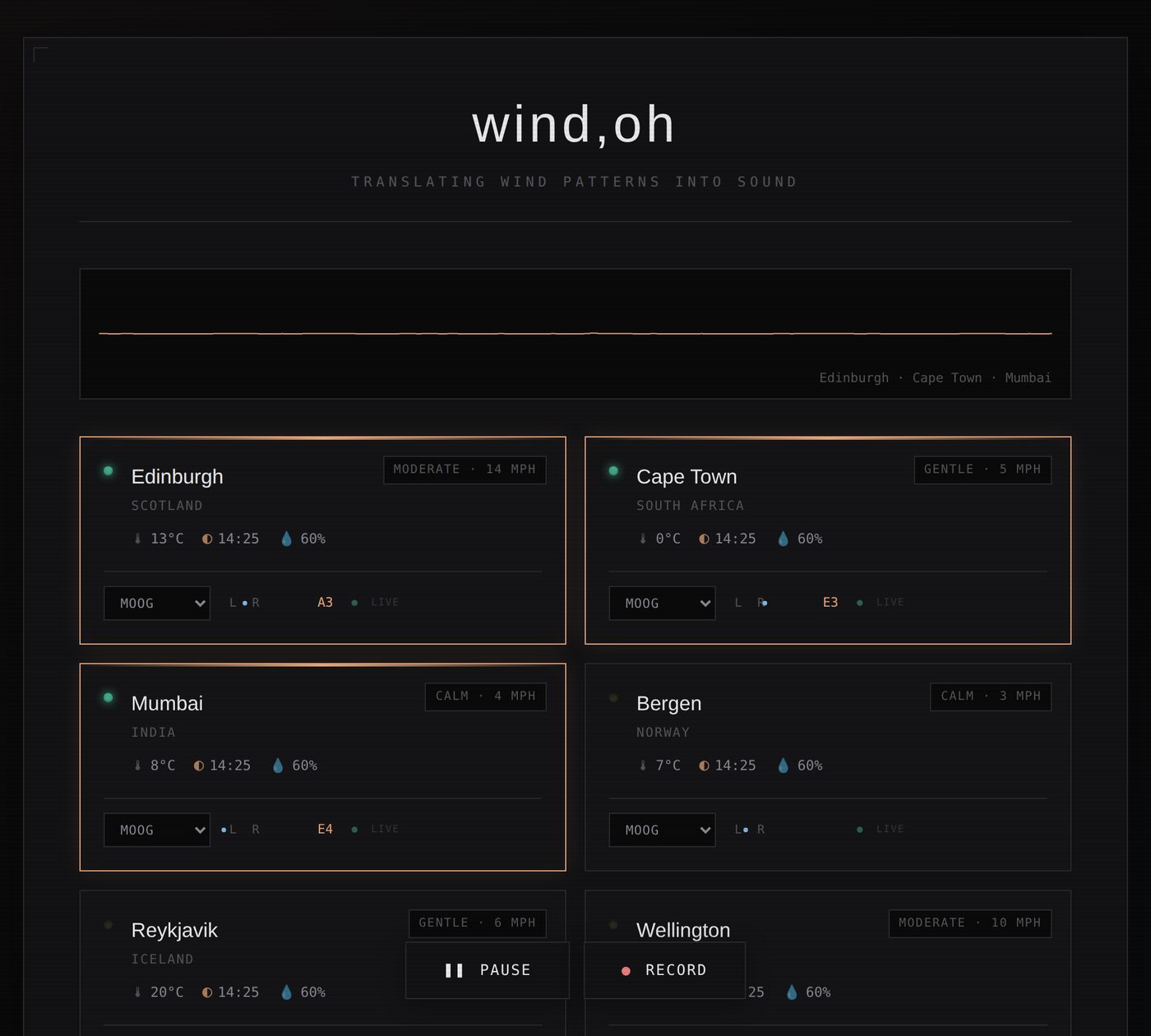
The version that got written down, with a full technical specification. Wind speed, direction, temperature and humidity set each voice. Direction placed it in the stereo field. Voices were modeled on classic synthesizers, and a waveform showed at the top. It added recording, and a solo mode to hear one city alone.
0.3Light
In daylight
The same instrument on white, to see whether it held up outside the dark.
0.2Voices
Every city its own voice
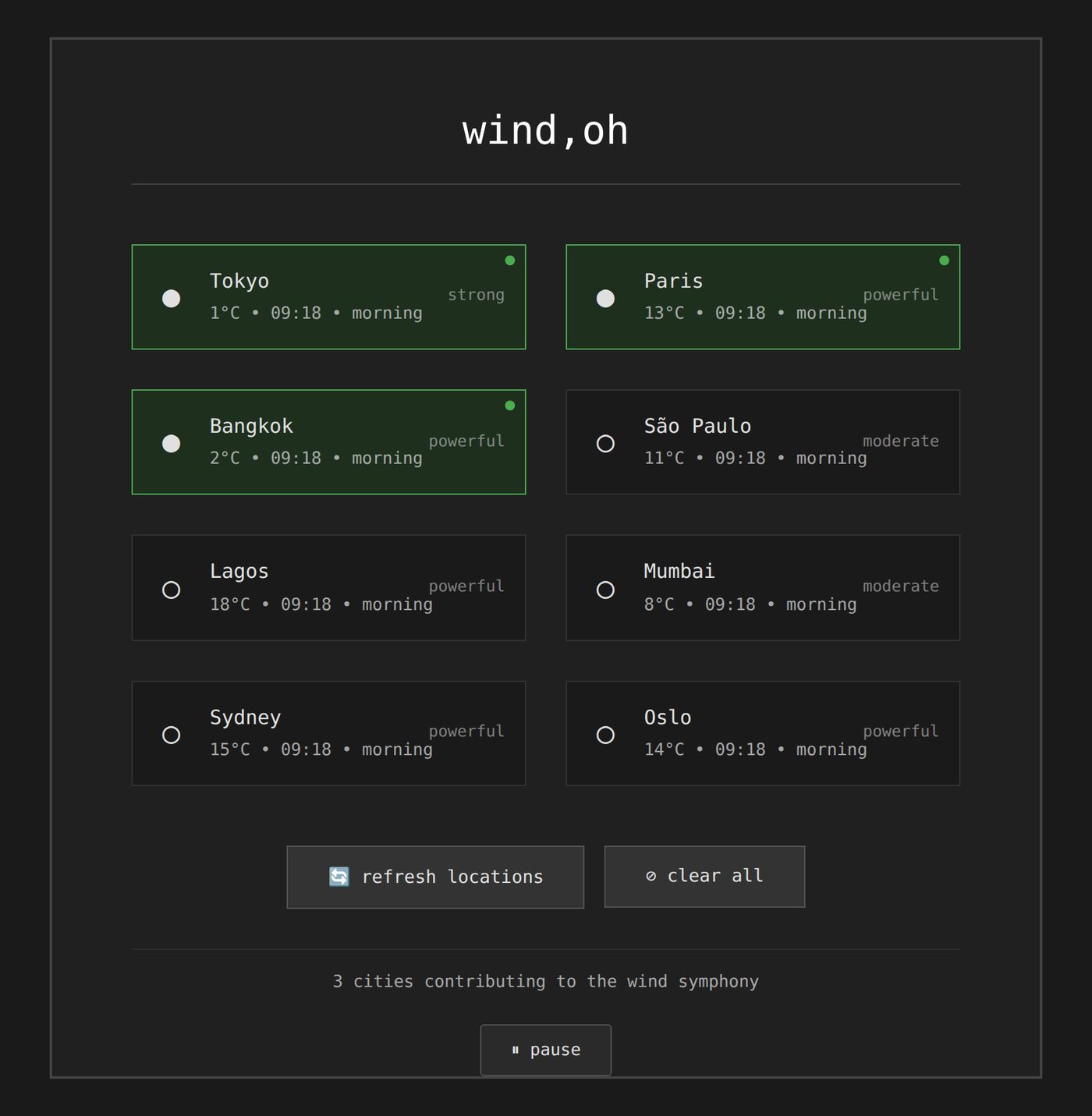
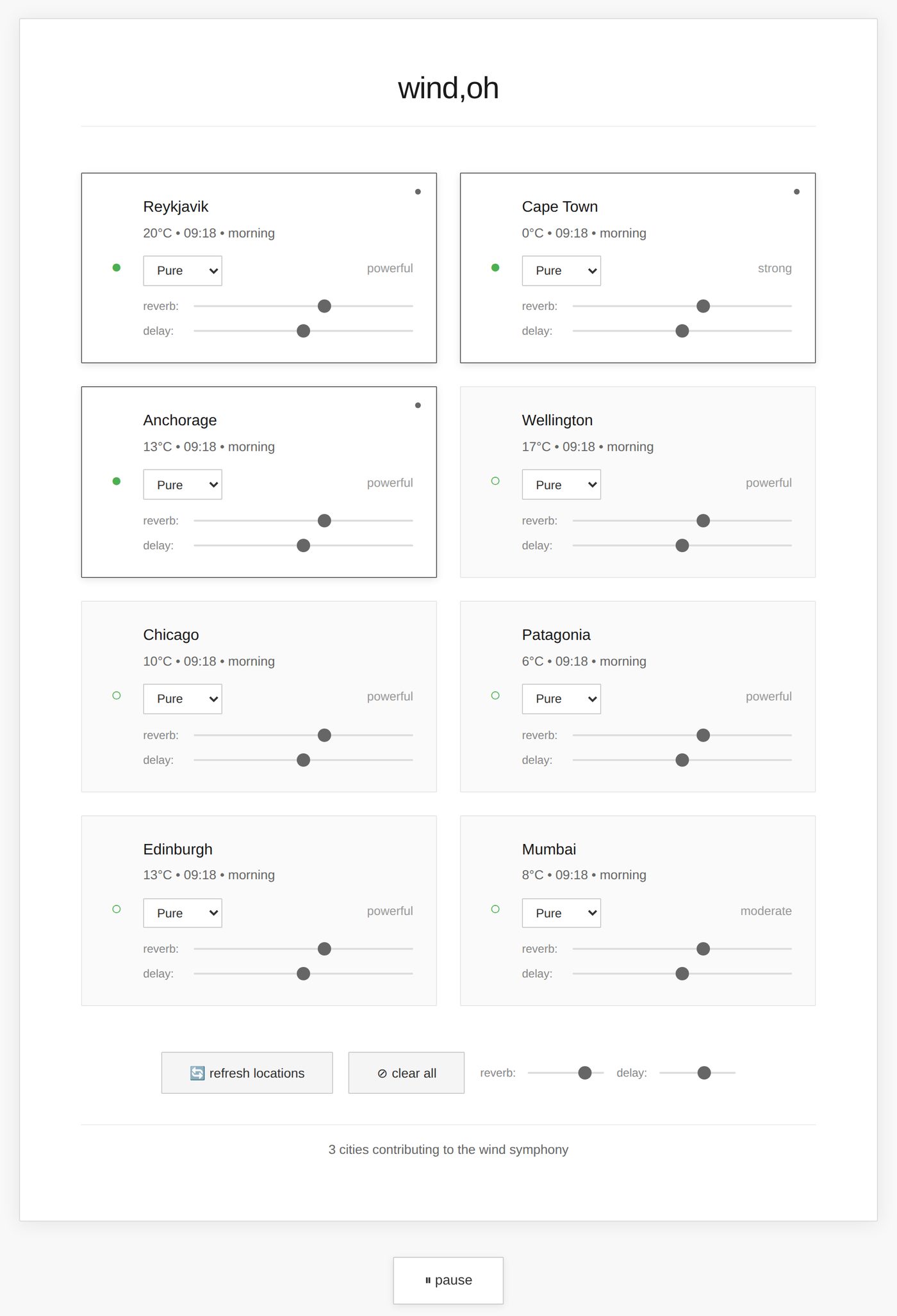
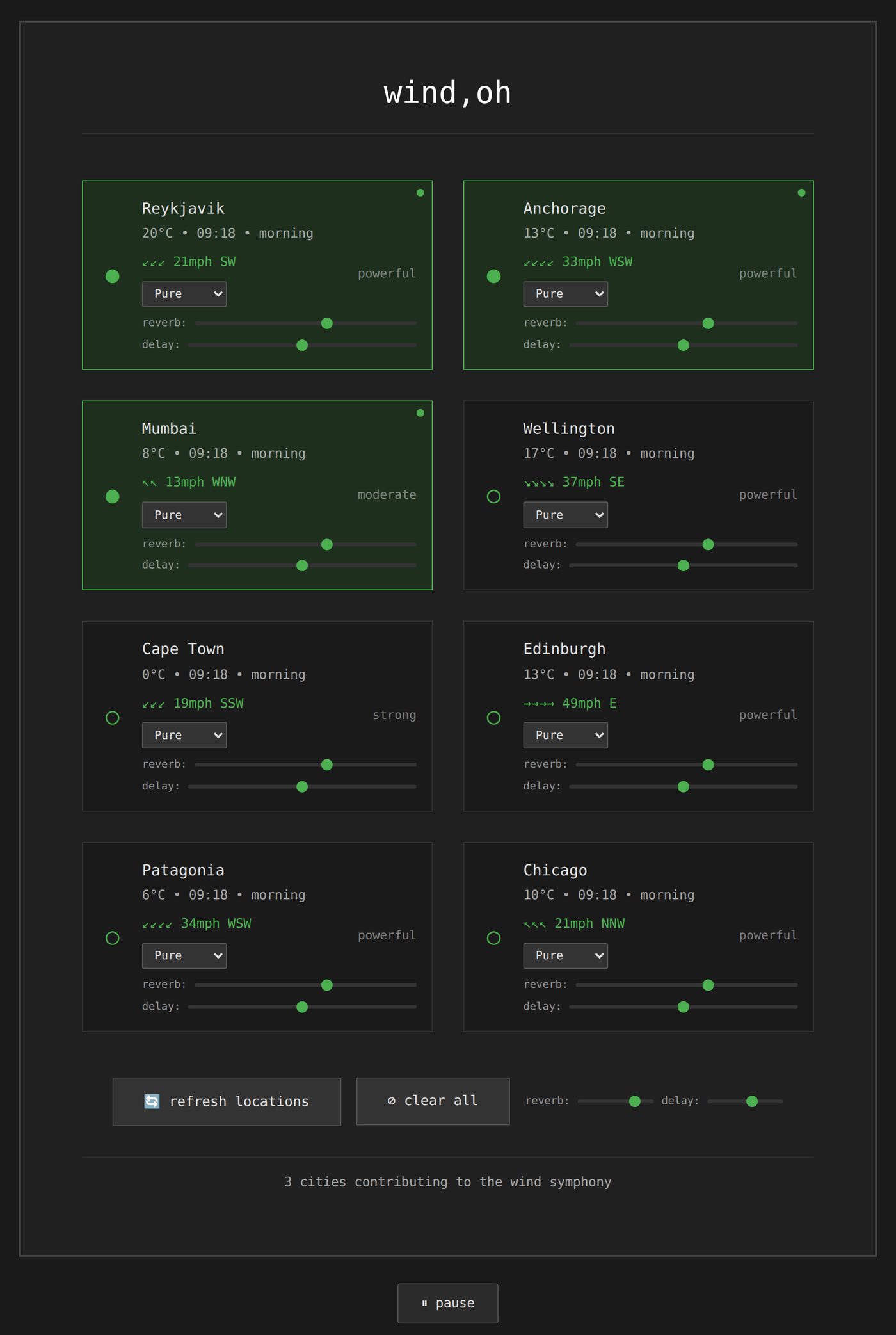
Each city got a voice, its own reverb and delay, and an arrow for its wind, repeated to show how hard it blew. Recorded piano chords joined the synthesis. A playing city lit up green.
0.1Sketch
The first sketch
Eight cities, live wind from Open-Meteo, one pentatonic scale so nothing could clash. You switched cities on and pressed “start listening”. The only line of copy: n cities contributing to the wind symphony.